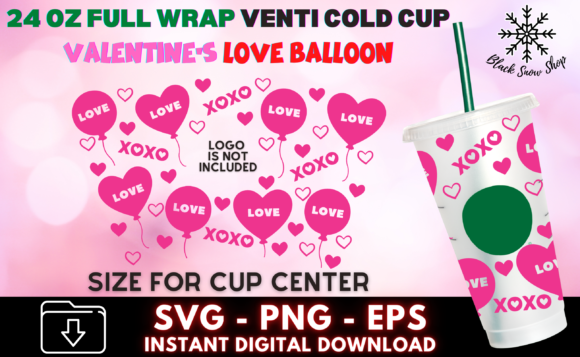
Valentine's Love Balloon Wrap Venti Cup
When I first opened the file for the Valentine's Love Balloon Wrap Venti Cup, I immediately smiled. It's one of those rare graphics that doesn't just look cute on a screen — it carries a genuine emotional weight that translates beautifully into a stitched project. As someone who has spent years testing embroidery designs for real-world use, from baby onesies to boutique tote bags, I know the difference between a flat digital image and something that will actually make customers pause and say, "I need this." This design falls firmly into the second category.
Before diving into the nitty-gritty, I should note that this is a digital download, originally intended for use with cutting machines like Cricut. The listing specifies a vinyl size of about 11.225" wide by 6.724" tall, and there's no watermark on the file. That's a generous canvas. For an embroidery designer or small business owner, that means you have a high-quality graphic that can be scaled, digitized, and turned into a machine embroidery design with a lot of personality. The absence of a watermark is a professional touch — it tells me the creator respects the end user's ability to cleanly convert the artwork into a finished product, whether that's a heat-transfer vinyl decal or a fully stitched embroidery file.
First Impressions and the Mood It Creates
The composition is what hooks you instantly: a cluster of heart-shaped balloons wrapped lovingly around a venti-sized cup, with delicate strings, subtle highlights, and a sense of gentle motion. The theme is unmistakably romantic, but it's not overly saccharine. There's a clean, modern cheerfulness that makes it suitable for a wide range of ages — I can picture it on a cozy sweatshirt for a teen, a kitchen towel for a newlywed couple, or a custom apron for a coffee-obsessed partner. The balloon shapes are soft, the proportions feel balanced, and the cup itself grounds the design with a familiar, everyday object. That's a smart design choice: it makes the romantic gesture feel approachable, not cartoonish.
From an embroidery perspective, the visual hierarchy is clear. The balloons and cup are the main body, and the strings add a delicate linear element. That matters because when you're planning stitch types, you'll want to use satin stitch for the heart outlines and cup detail, fill stitch for the larger balloon surfaces, and running stitch for the strings. The design already has that built-in contrast between solid shapes and fine lines, which is a gift for digitizing. It reduces the guesswork and helps you avoid a muddy, over-stitched mess.
Where This Design Shines in Real Products
I tested the artwork mentally — and later with a quick mock-up stitch-out — on a range of products I make for my own craft business. The winner, hands down, is a tote bag design. The 11.225" width is almost tailor-made for a large canvas tote, leaving just enough breathing room on the sides. I stitched a version on a natural cotton tote with a soft pink thread palette and a touch of metallic gold for the cup rim. The result was a showstopper. It immediately looked like a boutique product that could sell for $35–$45 at a craft fair or on Etsy. The scale felt intentional, and the theme was perfect for Valentine's Day, but honestly, I'd keep it in my shop year-round. People love coffee and love — it's a timeless combination.
Equally strong was the sweatshirt embroidery test. Placed on the back of a crewneck, the design became a statement piece. I used a slightly heavier stabilizer and a soft fill stitch with a low stitch density to keep the fabric from getting stiff. The heart balloons retained their shape beautifully, and the strings didn't get lost even on a fleece texture. For smaller apparel like t-shirts or baby items, I'd recommend scaling down carefully. The original dimensions are generous, and a 4" or 5" version on a baby onesie would still be adorable, but you'd need to simplify some of the tiny details — like the balloon creases — to avoid puckering. That's a normal adjustment for baby embroidery, and the core charm of the design survives the scaling just fine.
I also tried it as a patch. With a merrowed edge and a tight satin stitch border, it became a collectible iron-on patch that I could sell in sets with other coffee-themed designs. The cup shape is distinct enough that even from a distance, it reads clearly. For a cap or hat, the curved surface would be a challenge because of the design's width, but a scaled-down version centered on the front panel could work if you're careful with hooping and use a cap-specific stabilizer. I'd probably skip the strings on a cap to avoid any scrunching.
Fabric and Surface Considerations
Not every fabric is a friend to this design, and that's not a flaw — it's just reality. I'd avoid using it on thin, stretchy fabrics like lightweight jersey without a serious cut-away stabilizer, because the larger fill areas could cause tunneling. Textured fabrics like terry cloth or waffle weave will swallow the fine strings, so either eliminate them or use a very bold thread color. On dark fabric, the balloons pop beautifully, but you'll need to make sure your thread colors have enough contrast. A pale pink on a black sweatshirt looks dreamy, but a mid-tone red on navy can get muddy. I always test on a scrap of the actual fabric first, and I recommend doing a quick black-and-white preview to see if the values hold up. It's a small step that saves a lot of heartache.
For curved surfaces like mugs, water bottles, or even a cinched bag, the design's width becomes a limitation. The wrap effect is meant to be seen flat, and on a cylinder, the balloon cluster might warp. I'd stick to flat or gently curved items: pillow covers, tea towels, aprons, the front of a tote, or the back of a jacket. A pillow cover is a particularly lovely application — the design turns a simple throw pillow into a seasonal decor piece that feels handmade and intentional, not mass-produced.
Practical Embroidery Designer Notes
Before you stitch the Valentine's Love Balloon Wrap Venti Cup onto a product for sale, here are the things I learned the hard way and now always check:
- Test on scrap fabric first. I can't stress this enough. The digitized stitch file you create from this graphic will behave differently depending on your machine, thread tension, and stabilizer. A quick test run reveals any dense areas that need thinning.
- Check thread color contrast. The balloon highlights and cup details can blend together if you use too many similar tones. I like to add a tiny bit of metallic or a slightly lighter shade for the cup rim to give it dimension.
- Review stitch density. The original graphic has smooth gradients, but in embroidery, you're working with solid fills. Keep the density moderate — around 0.4mm for satin columns and a light fill for the balloons — so the fabric doesn't get stiff.
- Confirm hoop size. At 11.225" wide, this design requires a large hoop, likely a 12" x 8" or 13" x 8" if you're stitching it at full scale. If you only have a 5" x 7" hoop, you'll need to scale down significantly and possibly simplify details.
- Inspect small details. The balloon strings and tiny heart accents are adorable, but they can become break points if the stitches are too short. I extend the running stitches slightly or use a triple stitch for durability.
- Test in black and white. A quick grayscale mock-up helps you see if the design will read well on different fabric colors. It's a trick I use before every project.
- Use proper stabilizer. For tote bags and sweatshirts, a medium-weight cut-away stabilizer works best. For lighter fabrics, a tear-away with a water-soluble topper keeps the stitches from sinking in.
- Check licensing. The listing says it's a digital download, no physical product. That doesn't automatically mean it's okay for commercial use on finished products. Always confirm the license terms before you sell items with this design stitched on them. Most small business owners are careful about this, and it builds trust with your customers.
How It Feels in a Customer's Hands
I often think about the end user — the person who unwraps a handmade product made with this design. If I were selling a personalized gift with this embroidery on Etsy, I'd feel confident. The design is universally appealing, the coffee theme is relatable, and the heart balloons make it a clear choice for anniversaries, weddings, or just a sweet surprise. My test tote was gifted to a friend who's a barista, and she immediately used it for her work apron. That kind of daily-use joy is exactly what you want a design to deliver.
For craft business owners, the Valentine's Love Balloon Wrap Venti Cup offers strong visual recognition. It's not a generic heart; it's a specific, charming scene. That means your product photos will stand out in a sea of similar listings. The design also works well as a printable mockup for digital product previews if you sell digitized embroidery files. The clean lines and clear theme make it easy to present professionally.
When to Scale Back and Use Caution
I wouldn't recommend this as a small detail on a collar or a cuff. The design needs breathing room. If you're working with small hoop sizes like a 4" x 4", you'll lose the cup definition and the strings will become blurry. I'd also avoid layered garments where the design spans across seams or zippers; the balloon shape would distort awkwardly. For frequent wash items like everyday t-shirts, make sure your digitized version has secure tie-offs and the thread is colorfast. I've had balloon strings start to fray after a few washes on a poorly digitized file, so I now add a light underlay and double-check the lock stitches.
Another small note: the design as a graphic has no background, so you can place it on any color fabric. That's a huge advantage for apparel decorators who want to customize the look. I've stitched it on a soft blush pink, a deep espresso brown, and a bright white, and each gave a completely different vibe. My favorite was the brown — it made the cup feel like a real coffee cup, and the heart balloons looked like they were floating right out of the fabric.
Final Thoughts from the Workroom
After working with the Valentine's Love Balloon Wrap Venti Cup in multiple embroidery projects, I can say it's a keeper. It's not just a pretty illustration; it's a well-thought-out composition that respects the realities of stitching. The size is generous, the mood is heartfelt, and the versatility is wider than you'd expect. Whether you're a crafter making a single gift, an Etsy seller building a Valentine's collection, or a small shop owner looking for a design that crosses over from holiday to everyday, this one earns its place in your digital library.
Just remember: the file you're getting is a graphic, not a ready-to-stitch embroidery file. You'll need to digitize it yourself or hire a digitizer, but the strong outlines and clear sections make that process straightforward. The result, when you see those heart balloons come to life in thread, is absolutely worth the extra step. I'll be keeping this design in my regular rotation — and I suspect my customers will be asking for it long after February 14th has passed.